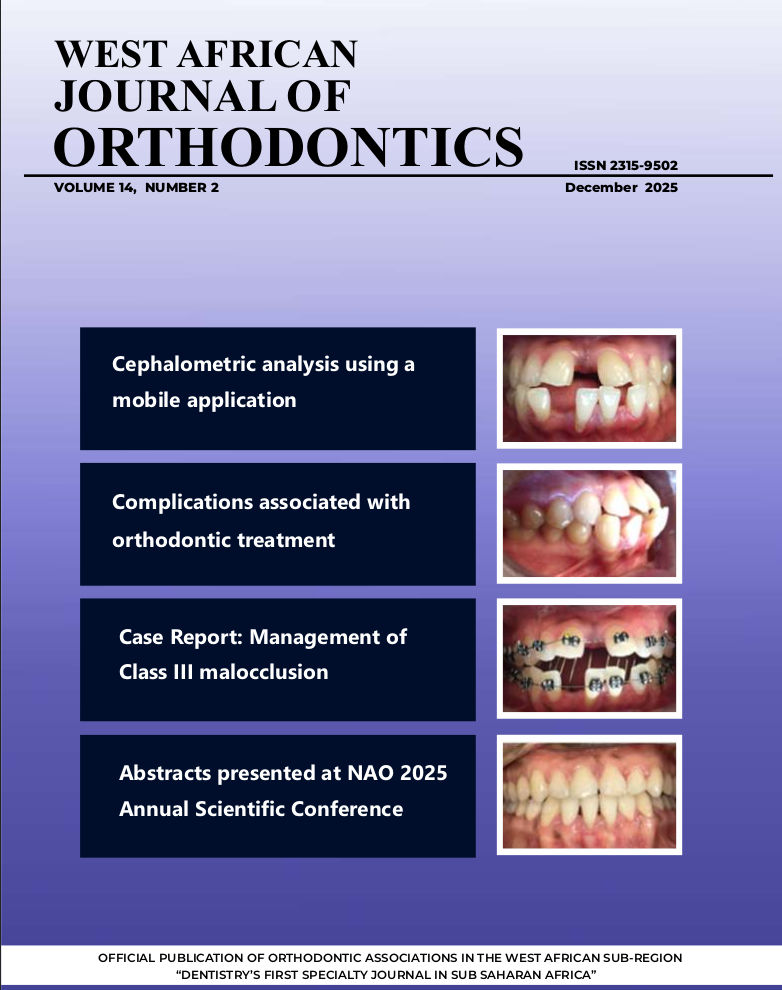
A Three-Year Review of Complications associated with Orthodontic Treatment in A Nigerian Teaching Hospital
Abstract
Background: Orthodontic interventions, though effective in correcting malocclusions, can lead to undesirable oral complications that may affect treatment efficiency and patient comfort. Therefore, this study aimed to document complications occurring during and shortly after orthodontic management and the treatment duration with fixed or removable appliances at the Obafemi Awolowo University Teaching Hospitals Complex (OAUTHC), Ile-Ife, between 2021 and 2023, in order to examine relationship between these complications and treatment length.
Methods: This was a retrospective analysis that involved the review of clinical records of patients who received orthodontic care within the study period. Information on complication categories, duration of treatment, and appliance type was extracted. Statistical analyses were conducted using SPSS (version 25), and associations between variables were tested with the Chi-square method. Approval for the study was granted by the Institutional Ethics Committee (IPH/OAU/12/2034).
Results: Out of 90 eligible patient records, the most common adverse event was gingival hyperplasia (63.1%), followed by gingival pain and swelling (17.9%), mucosal ulceration (9.5%), and other less frequent periodontal issues (9.5%). A statistically significant difference was observed between complication type and treatment stage (?² = 19.13, df = 7, p = 0.008). Astatistically significant difference was also seen between complication type and treatment duration (?² = 52.41, df = 21, p < 0.001).
Conclusion: Orthodontic complications varied between stages of treatment and duration. Gingival hyperplasia emerged as the predominant complication, particularly in prolonged treatment cases. Routine periodontal assessment and timely intervention may reduce the incidence and severity of such outcomes.