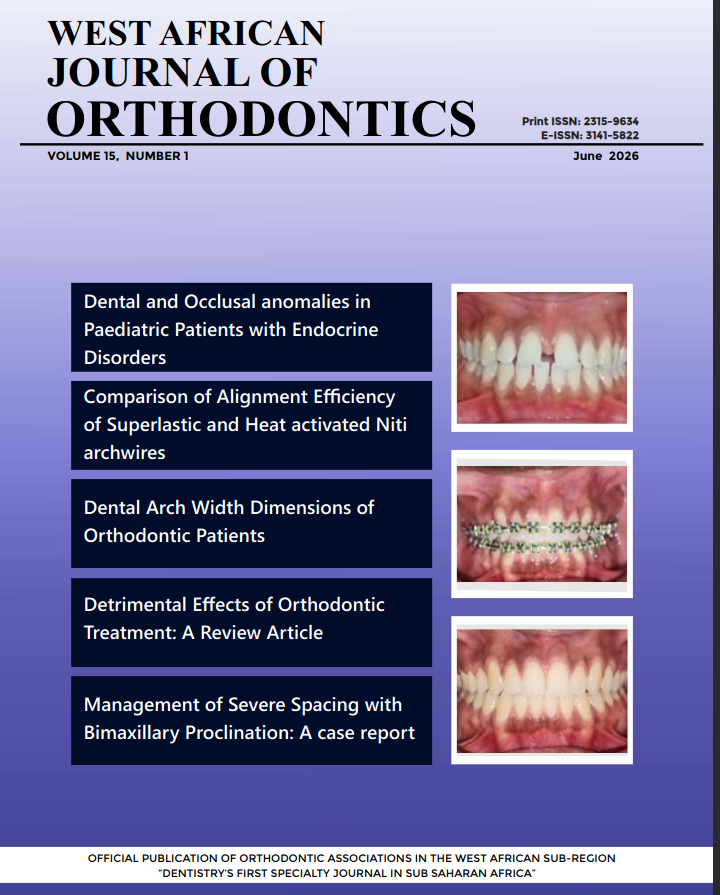
West African Journal of Orthodontics
Prevalence and Distribution of Dental and Occlusal Anomalies in Paediatric Patients with Endocrine Disorders at The Lagos University Teaching Hospital, Nigeria.
Abstract
Abstract
Background. Dental anomalies involve abnormalities in the number, size, and shape of teeth, as well as structural defects or
disruptions in the eruption pattern . Genetic and epigenetic defects throughout the stages of tooth development have been the
main aetiological factors. Occlusal anomalies, such as crowding, spacing, deep bite, open bite, and crossbite, are deviations
from the normal alignment of teeth and jaws. Endocrine disorders such as hypothyroidism, growth hormone deficiency, and
acromegaly are associated with various dental anomalies, including enamel defects, delayed tooth eruption, changes in tooth
size, and position. The identification of dental and occlusal anomalies is important since they can cause disturbances such as
malocclusion, increased susceptibility to caries, and aesthetic concerns.
Aim. To determine the prevalence and distribution of dental and occlusal anomalies amongst paediatric patients in the
paediatric endocrinology clinic, LUTH.
Methods. This is a Hospital-based Cross-Sectional study conducted at the Paediatric Endocrinology clinic, LUTH. Informed
consent and assent were obtained. Ethical approval was obtained. Participants were recruited via a convenient sampling
technique, until 50 participants aged 7-18 years, were obtained with a confirmed diagnosis of an endocrine disorder by the
physician. Clinical examination was done with dental examination sets. Data was analysed using SPSS version 26 with a p
value set at <0.05.
Results. A total of fifty participants with 54.0% females and 46.0% males participated in the study with a mean age of 11.52 ±
4.9 years. The prevalence of dental and occlusal anomalies was 56.0%. The frequencies of the various occlusal and dental
anomalies included Crowding 16.0%, Crossbite 16.0%, Open bite 16.0%, Missing teeth 8.0%, Enamel defects 16.0%, and
Microdontia 2.0%.
Conclusion. Dental and occlusal anomalies are prevalent and commonly distributed amongst paediatric patients with
endocrine disorders. Timely identification can minimise complications by enabling early treatment planning, less extensive
interception, and a more favourable prognosis.
Keywords: Dental and Occlusal Anomalies, Endocrine Disorders